ninas handyman services

"They get here on time, they work efficiently, and they get the job done correctly." "He does high-quality work and he's easy to get along with. He's not going to be the fastest guy in the world and he typically works alone, but that's not a criticism. He gets the job done and he gets it done in a reasonable amount of time. I've used him about a half a dozen times and I've been happy every time." "He's reliable, he gives you good advice, and he does good work." "He is friendly, easy to work with, he communicates with you, and he gets back to you right away." "I would highly recommend him." "He's reliable, does good work, and he has a lot of integrity." "Hire them, he does good work." "He's very easy to work with and he knows what he's doing." "He's just very slow and I think it's because he's the only person doing the work." "He's reliable, on time, and responsible. " "It served its purpose and they fulfilled my needs." "He's very competent, prompt, and considerate." "He gets the job done in a timely fashion. "

"I was really impressed with the quality of the finished work, I felt that his finished work was exemplary." "He's always punctual, professional, and gets the job done exactly as I want." "It's a good name. He shows up when he says he's going to show up, he's a very good problem solver, and he's quick with communication. He's done projects on my rental properties and I have a lot of confidence that he'll get the job done." "I believe that he's a Diamond Certified company." "He's very pleasant to work with, they have good pricing, and they stay on budget. He always does what he says he's going to do and he's a really cool guy." "He's multi-talented and very responsive."For best results, please add a location. Affordable Painting & Services, LLC 9 years in business Principal: Zeb O. Sartin, Owner Painters - Commercial or Residential Construction & Remodeling Services Licensing, Bonding or Registration BBB Reason for Ratings BBB rating is based on 13 factors: Get the details about the factors considered.

Despite her modest upbringing, Simone nurtured an interest in music from a preternaturally early age, learning the piano at the age of three.
handyman services in oxfordAs a teen, she aspired to be a concert pianist, but these dreams were hampered when she was denied scholarship to the Curtis Institute of Music on the basis of her race. It wasn’t until she was discovered by Bethlehem records in 1958, while performing in an Atlantic City night club, that Simone emerged as the artist we know her as today. The career that followed was as long as it was lively. From the late 50s through her death in 2003, Simone released over forty albums, each with her signature combination of gospel, jazz, and classical music. Known for her strong opinions and fiery personality, she was unafraid to ruffle feathers (or take shots if she didn’t take kindly to you). In the mid 1960s, her music took on a decidedly political tone with songs that dealt with segregation and racial inequality.

Simone is probably most legendary for her extraordinary voice, cool style and idiosyncratic stage presence. Often coupling her performances with drawn-out soliloquies, her languid cadence and poetic non sequiturs endowed her with a hypnotic, regal quality. A performer through and through, Nina Simone is one of those fascinating, rare artists whose craft extends beyond her music and into her persona, painting a beautiful and oftentimes entrancing portrait. 1. Black jumpsuit | 2. Missoni Turban | 3. Gold & Turquoise Bib Necklace | 4. Marcel Wanders Knotted Chair | 5. Eye Do Liquid Eyeliner | For someone whose star was almost in total eclipse when she died 13 years ago, Nina Simone’s light is shining brighter than ever. Known for her uncompromising artistry, her stalwart support of the civil rights movement and her struggles with mental illness and domestic abuse, the singer is the subject of two recent high-profile films and a new play. Meanwhile, such songs as “To Be Young, Gifted and Black” and “Mississippi Goddam” are being downloaded by a new generation of fans.

What makes this time ripe for a Nina Simone revival? She holds up a mirror not just to our past, but our present, said playwright Christina Ham, whose “Nina Simone: Four Women” premiered this month at Park Square Theatre in St. Paul. “Nina was, first and foremost, an authentic artist of uncompromising excellence,” Ham said. “She used her art to serve a larger cause of freedom, though many of the battles that she fought in her lifetime remain unfinished and have been taken up by the Black Lives Matter movement. So our fascination with Nina as muse and vessel is also about her and us. The times call for her.” Simone’s voice continues to be part of the pop-music conversation, via samples in Kanye West’s music and as an inspiration for a raft of artists, from the Fugees to Mos Def. “Because I fed on this music … I believed I always had a right to have a voice,” said singer Lauryn Hill. “Her example is clearly a form of sustenance to a generation needing to find theirs.
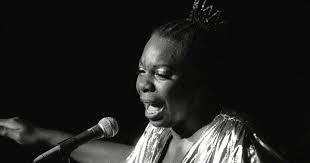
Hill repaid that gift last year with an all-star tribute album, “Nina Revisited.” She contributed six tracks to the disc and served as executive producer. “Simone’s mix of headiness and haunt, [her] lyrical boldness and political bombast make her the hero of our hip-hop generation,” wrote Salamishah Tillet, a University of Pennsylvania professor who is writing a biography of Simone. “We look to her as our muse; we listen to her because we want to know what freedom sounds like.” Simone’s currency in hip-hop speaks to a search by artists for clarity and authenticity in an unsettled moment when prepackaged pop acts just won’t do, said Duchess Harris, a Macalester College professor and co-author of “Black Lives Matter,” a contemporary history text for middle schoolers. “We’re in a moment of introspection and confusion as the Obama presidency winds down and as a figure like Donald Trump, who makes racist appeals, rises,” Harris said. “People want their music to be political again — to say something.

They want authenticity in their artists, not just a commercial product. Nina did for many of the older heads what someone like Kendrick Lamar is doing for young people today.” Simone’s gripping personal story is well-told in Liz Garbus’ Oscar-nominated 2015 documentary “What Happened, Miss Simone?” It frames her life and art in the context of her struggles to be free, even as she confronted intimate violence and mental illness. Born Eunice Kathleen Waymon to a handyman and a maid who also was a minister in the Jim Crow South, she grew up with seven siblings in a 600-square-foot house in the resort town of Tryon, N.C. Showing musical talent at an early age, she was encouraged to pursue her dream of becoming a classical pianist who would one day play Carnegie Hall. She practiced eight hours a day, all but missing out on her childhood. But when she auditioned to study at the Curtis Institute of Music in Philadelphia, where her family had moved to support her dream, she was rejected.

That stung even more deeply because of the suspicion she was denied not for lack of skill or talent, but because of her appearance — dark skin, with full lips and a flat nose. She stayed in the Philadelphia area and eventually found another path forward, singing in Atlantic City nightclubs under a new name, out of fear her devout family might find out. Her first hit was a recording of Gershwin’s “I Loves You Porgy,” in 1958. She would later make 40-plus albums, all reflecting her catholic styles and tastes — a mix of classical influences, jazz, blues, gospel, folk, pop and R&B that earned her the sobriquet “The High Priestess of Soul.” But she did not want to be limited in her expression, as a musician or as a human being. “I wish I knew how/It would feel to be free/I wish I could break/All the chains holding me,” she sang in 1967. Angered by American politics and her own diminished stardom, she left the United States in 1970, moving restlessly from place to place — Barbados, Liberia, Switzerland, the Netherlands — before settling in France, where black expatriates such as Josephine Baker and James Baldwin had long made a home.

While she escaped some of her demons abroad, she had diminished resonance back in the States. It was her death in 2003 at age 70 that jolted longtime admirers into action. But whenever her name is invoked, controversy has sometimes been an unbidden companion. That is certainly true of the biopic “Nina,” scheduled for release April 22 and starring Zoe Saldana of “Avatar” and “Guardians of the Galaxy” fame. Simone’s daughter, Lisa Simone Kelly, who worked on the 2015 documentary, has criticized the script for taking liberties with her mother’s story. She also questioned the casting of Saldana, who neither resembles Simone nor has much singing experience. Prof. Harris said Saldana, who used dark makeup and a prosthetic nose to play the part, should have stepped aside, given the complicated history of skin-tone discrimination that blacks practice against one another as a carryover from slavery. (Saldana is of Dominican, Puerto Rican, Haitian and Lebanese descent.)

“I’m disappointed that she didn’t understand what it means for her to play the role,” Harris said. New York-based filmmaker Tanya Steele, a Simone devotee, also is taken aback that the recent films about Simone give voice to those who abused her. “My connection to her is so personal,” Steele said. “When I listen to her music, she’s not just talking to me, she’s talking through me. Through her life and art, she’s given me permission to go where I need to go and do what I need to do, creatively. Nina was political, but she always led with her art. Her voice still holds up a light for those dealing with similar social issues today. In a filmed interview from the 1960s posted to YouTube, Simone invoked artists of all stripes, saying it is their duty to reflect the era in which they live. “At this crucial time in our lives, when everything is so desperate, when every day is a matter of survival, I don’t think you can help but be involved,” she said.