business for sale aylmer ontario

Welcome to Shades of Green. We are thrilled that you have found our site! We are a family-owned business just south of Aylmer, Ontario, Canada. We specialize in hostas, the number one perennial on the market for many years now. They are so popular that in 1998 they were deemed the friendship plant. Just one of the many reasons why we love hostas! One never knows what treasures they will find here! We have ever changing display gardens for our friends and customers to stroll through and enjoy. As you stroll, you can see how the plants perform in the garden setting, rather Our hostas and daylilies are available for purchase online. We have had great success in shipping these. Perennials, such as astilbe, ferns, heuchera, etc., we would love to have you come for a visit and purchase these in person. Our online availability will change as our stock grows and depletes. If there is something that you are looking for and don’t see it, please e-mail us as we may have it in stock, but in too few numbers to post on-line.
We are open every day May through September starting Mother’s Day weekend. Please see the 'Contact Us' page for hours. One of the greatest joys to this business is meeting fellow gardeners. We look forward to having you come in for a tour and a visit. If you are coming to see us in person, you will find that there is always something interesting to see around the next corner in our gardens. They are a constant work in progress as we strive to make them better every year! If you would like to book a tour, please contact us to make arrangements in advance so that we can assist you in making your day enjoyable. Our daylilies are hardy and healthy! We sell mature divisions of field grown daylilies and always ship freshly dug plants. There are more varieties available at the nursery than we have listed online! Image pictured is Hemerocallis 'Annie Gray'. Our hostas are field grown from either division or from tissue culture. We ship healthy, mature divisions. Please keep in mind when ordering that the latest releases of hosta will be smaller divisions as they will not have had as much time to grow as the older varieties.

Image pictured is Hosta 'Lean On Me'. For those of you coming to visit us at the nursery, we have many companion plants for the hostas available for sale.
handyman in durham ukWe have expanded our selection of Heucheras and Ferns this year.
business for sale gansbaaiAlso, we have added Arisaema (Jack-in-the-Pulpit), Astilbe, Brunnera, Dicentra (Bleeding Heart), Epimedium, Helleborus, Ligularia, Polygonatum (Soloman's Seal), and Trillium.
handyman new orleans areaImage pictured is Heuchera 'Frosted Violet'.
business for sale 34986In rural Ontario, 800 kilometres from the nearest ocean, you will find the unexpected — a successful inland shrimp farm.
imperial handyman services
With pork prices low, Paul and Tracy Cocchio were struggling to make a profit with their hog farm in Campbellford, Ont., so they started looking for alternative uses for their empty barns.
one stop diy vape shopWhile searching the internet they stumbled upon farmers in the U.S. who had switched to inland shrimp farming. They decided to give it a shot themselves. Shrimp is the most consumed seafood in North America and the majority of the shrimp eaten on the continent comes from Asia. But the industry there has become highly controversial because of labour practices and pollution. "Shrimp is in just about every restaurant and it's all imported. There are some Canadian harvests but they're small and these bigger shrimp are all imported. So we knew there was a good market," said Paul Cocchio. The Cocchios converted one of their 60- by 12-metre hog barns into a tropical shrimp farm with 100 per cent humidity and 16 tanks filled with 29 degree water, but creating their company First Ontario Shrimp hasn't been an easy process.

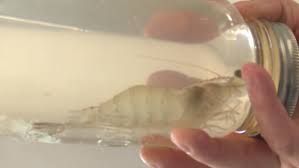
It took them three years to get Pacific white shrimp added to the list of species that can be farmed in the province and it took another three months to obtain an actual licence to farm them. This shrimp was farmed by Paul and Tracy Cocchio who converted an unused hog barn several years ago into an aquaculture facility, and now can't keep up with demand for their shrimp. It also hasn't been easy keeping the tiny crustaceans alive. "We thought, 'Oh, look at that: They're all hugging each other, swimming around.' They're eating each other, they're hungry," said Paul. All of the Pacific white shrimp they farm comes from Florida by 24 hour express mail and are only about the size of an eyelash when they arrive. "They send us about 20,000 at a time. So we put them in a starter tank, look after them for three to four weeks in that starter tank. Then they go into a finishing tank for about four to four and a half months to get them to the size that we're wanting," said Paul.

The Cocchios' son Brad has been involved in the operation from the beginning and takes great pride in what his family has been able to develop and how little impact it has on the environment. "There is no water that leaves this place. There's no filters or anything. Basically the bacteria that's in the water is consuming the waste from the shrimp, the excess feed, all of that. And then when it flourishes the shrimp eat it," said Brad. It took Paul and Tracy Cocchio three years to get Pacific white shrimp added to the list of species that can be farmed in the province. Environmentalists say that what the Cocchio family is doing is the most sustainable way to produce shrimp. Teddie Geach, a seafood specialist with Oceanwise, has given their shrimp farm a stamp of approval. "Our oceans are a limited resource and we've already seen that overfishing is the number one impact that we're having on our oceans. So providing alternate sources of protein is going to be really essential in the future," Geach said.

Closed shrimp farming is viewed as a much better alternative compared to open pond shrimp farming in Asia where feed, antibiotics, and any excess waste goes right back into the environment. A recent Associated Press investigation in Thailand also uncovered slave labour being used in the farming process there. Toronto entrepreneur Marvyn Budd, meanwhile, aims to take shrimp farming in Canada to a whole new level. He is building a much larger shrimp farm in a former Imperial Tobacco plant in Aylmer, Ont. "We're starting with four production modules, each of which have long raceways that are each about the size of a football field," he said. "Eventually we'll end up with 224 football fields and about 14,000 miles of shrimp production. That's a lot of shrimp." Budd's operation, called Planet Shrimp, won't be up and running until June 2016. His company plans to produce 3,600 kilograms of shrimp a week to start and as they continue to expand the goal is to increase volume to more than 29,000 kilograms per week.

"We'll be the focal point of the shrimp industry. I think we are going to change how shrimp is farmed all over the world," said Budd. The Cocchio family is already changing the industry. After all of the challenges and steep learning curve, their farm is starting to have some success. They are harvesting almost 70 kilograms of fresh shrimp every week, but that's still not enough to keep up with the orders. "Every day we have e-mails and phone calls wanting to know how they can get our shrimp. Our supply does not meet the demand," said Tracy Cocchio. Several restaurants in the Toronto area have been purchasing their shrimp for months now. Once a week or so, the Cocchios harvest the shrimp in the morning and drive their fresh product to their customers that afternoon. "You really do taste that extra little bit of freshness that only being a couple hours out of town makes," said Kevin Flaherty who works at Honest Weight seafood restaurant and fish counter. They often sell out of the Cocchios' product within a day.