handyman service level agreement

Tax Calculators & Tips / Tax Tips for Handymen and Odd Jobs If you work as a handyman or do odd jobs around town for money, you are operating a business in the eyes of the IRS. Since you own your own business, you're likely a self-employed sole proprietor. This means you'll have lots of potential tax deductions to investigate. When you work for yourself, you file the regular Form 1040 as a self-employed person. However, instead of reporting your income on line 7 as wages, salary or tips, you report it as business income on line 12. But you don't report the total sum of all income you receive from your handyman business. First use Schedule C to calculate your net income after taking all appropriate business deductions. Handyman Business Deductions on Schedule C or C-EZ If you pay for something that helps you earn income from your handyman business or odd-job work, you may be able to deduct it as a business expense. Examples of allowable business deductions include:
Business use of your car — either actual expenses or the standard mileage rate deduction of 54 cents a mile in 2016 Equipment, furniture and supplies you use in your business Home office expenses if you use part of your house exclusively for your business Telephone and Internet — 100% if you use these services only for business, otherwise a proportionate amount Training costs related to being a handyman Careful Record-Keeping Is Essential Do yourself a favor and keep careful records of handyman income and expenses from the beginning. This makes preparing your tax returns easier and smoother. Even if you don't work full time at odd jobs, you can make record keeping easier by: Maintaining separate bank accounts for your handyman business Applying for new credit cards used only for your business Storing all receipts and invoices in organized files Keeping precise mileage logs reflecting odometer readings by job name Self-Employment Taxes and Estimated Payments for Handyman and Odd-Job Income

But an interface contract, no matter how brilliant, is nothing without some explainations. A fully documented OpenAPI specification file can provide some useful information and be used as a part of an API’s documentation.
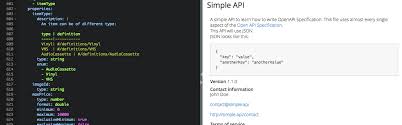
homestead handyman service This tutorial is composed of several posts: In previous parts we’ve learned to create highly accurate API description, in this seventh part we’ll learn how to use the OpenAPI specification to make it a valuable part of an API documentation. All tutorial’s files are available on GIST. If you’re a bit lost in the specification, take a look at my [visual documentation: OpenAPI Specification Visual DocumentationWhen using an API, API consumers want to have some general informations about it like its version, its name, some description, term of service, how to contact the API provider, what kind of licencing it uses. The info object placed on root level can be used to provide such information:

By using tags on operation level, we can categorize operations. tags is a simple list of names. This operation belongs to the Person category: An operation can belong to different categories: We can add some descriptions at almost every level of the OpenAPI specification. A description can be added to security definitions: Each schema (used in a definition, a parameter or a response) can have a title and a description: Properties can be described with description: Whether defined inline or in parameters section, a parameter can have a description. An operation can be described with a summary and a longer description. An operationId can be added. It can be used as a link to the implementation running behind the API for example. Whether inline or defined in responses, a response can have a description. Headers returned with a response can have a description: Tags can have descriptions. We need to add a tags section on specification file root level, on each item in this list we set a name (corresponding to the name used in tags list on operation level) and a description:

In almost all description, we can use GFM (Github Flavored Markdown). To check if an object description support GFM, take a look at my visual documentation or the original specification. Note that GFM support can vary depending the tool processing the OpenAPI specification file. By adding a | and a new line with a new tab, we can write multiline descriptions: Examples can be provided for atomic or object properties, definitions, and responses. Atomic properties can be illustrated with an example: Object properties, can also be illustrated with a complex example complying to the underlying JSON Schema: An example can be defined for the entire definition just like for an object property (it must conforms to its underlying JSON schema): On response level, we can provide example, each one corresponding to a media type returned by the operation. Here’s an example for an application/json media type: If we defined examples on multiple levels (property, object, definition, response), it’s always the higher level which is taken into account by tools processing OpenAPI specification file.