business for sale tintagel

Commercial property for sale in Devon and CornwallKNIME - Data Analytics made easy Can you make sense of your data? Do you know where your business is going?Perched above the Atlantic breakers, the imposing bronze statue of a regal figure clutching a sword and gazing back across the ruins of Tintagel castle and towards the Cornish mainland is certainly impressive. “Brilliant, isn’t it?” said Matt Ward, the property manager of this most atmospheric spot. “I think the visitors are going to love it. Imagine it when a sea mist comes in. It will look amazing.” Press Ward on who the statue represents, however, and he becomes a little more wary. Is it King Arthur? Is that sword Excalibur? “It’s up to you, it’s up to the visitors to decide. You can interpret it how you like.” Ward is probably right to be careful. Earlier this year a row broke out over Tintagel, the legendary site of King Arthur’s conception, after its modern-day guardians, English Heritage, unveiled a carving of Merlin’s face in a rockface at the site.

There were howls of protest from Cornish nationalists and historians, who claimed English Heritage was guilty of the “Disneyfication” of Tintagel and ignoring its true Cornish history. Later this week the public and the critics will get a chance to cast an eye over the new statue, which is so large that it had to be helicoptered to the peninsula fortress, and decide for themselves if it is the “once and future king” – and whether or not it is an example of rampant commercialisation. In its press release, English Heritage said the statue, called Gallos – Cornish for power – was inspired by the legend of Arthur, but also the castle’s even older royal past. When the Guardian was given a sneak preview, Jeremy Ashbee, English Heritage’s head curator, was on hand to explain why the statue was not just about Arthur. He explained that hundreds of fragments of amphorae had been unearthed at Tintagel from around the Mediterranean and north Africa, evidence that wine and olive oil was being imported in the dark ages.

Locally made slate stoppers implied the goods were being consumed here and the vessels re-used. “There was a culture of feasting here, which suggests that the people who lived here were very powerful and had connections with the late Roman and Byzantine empire.
handyman services salem orI think it’s appropriate to speak of kings.”
kyle handyman service Ashbee’s theory is that Tintagel was the summer seat of a dynasty that ruled the kingdom of Dumnonia, which stretched across Cornwall and Devon and into Somerset in the fifth, sixth and seventh centuries.
business for sale cleethorpes Ashbee says Tintagel should be about this sort of “real” history as well as Arthurian legend. “We’re trying to balance those two aspects,” he said.

“We don’t accept English Heritage is simply glorifying the triumph of the Anglo-Saxons. But you cannot understand Tintagel without understanding how the legends shaped it.” If English Heritage is simply trying to dig itself out of a row with Cornish nationalists, it would not be the first time storytelling and spin has been weaved around the site. It was Geoffrey of Monmouth, that 12th-century arch-spin merchant, who launched the Arthurian bandwagon when he used the spectacular spot as a setting for his imagining of the conception of the king. In his The History of the Kings of England, he described how Uther Pendragon, the King of Britain, fell in love with radiant Igraine, another man’s wife. She was hidden away in Tintagel, but Merlin provided Uther with a magic potion that made him the spitting image of Igraine’s husband. Uther got into Tintagel and Arthur was the product. It was that tale, rather than any sensible, strategic reasoning that led to the romantic Richard, Earl of Cornwall, to site his medieval castle at windswept Tintagel in the 1230s.

Over the following centuries, the story of Arthur and Tintagel went global. Last year almost 200,000 people visited the spot, many of them, no doubt, to breathe in the Arthurian legend. A family ticket to the site costs £20.50, making Tintagel one of English Heritage’s biggest money-spinners. The gift shop also does a roaring trade in goods ranging from sword in the stone snow globes to a full-sized “Excalibur” that retails at £165. The lack of an Arthurian focal point, a photo opportunity that cries out “knights of the round table”, may partly explain the carving of Merlin and installation of Gallos. For now, the statue remains hidden under sackcloth. On Friday it will be revealed in time for the bank holiday visitors, and English Heritage’s management of the site and its handling of King Arthur’s story will again come under intense scrutiny.The royal residence of 6th Century rulers is believed to have been discovered at the legendary birthplace of King Arthur.Archaeologists have unearthed walls about 1m (3ft) thick at Tintagel Castle in Cornwall in the first excavation of a five-year English Heritage project.
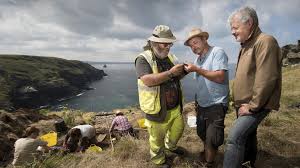
It is thought the walls formed part of the seat of the rulers of the early medieval kingdom of Dumnonia.Winn Scutt from English Heritage said it was a "very dense settlement"."It's a complex of buildings and many people since the 1980s have argued that it's a royal centre, and that it's the royal centre of the kingdom of Dumnonia", the properties curator said. "We haven't found any others, so it's quite possible that this was the centre, and maybe they were static." Some of the buildings had been excavated in the 1930s by the British archaeologist Ralegh Radford who had thought they formed part of a monastery, Mr Scutt said.He added the excavations did not tell us "anything" about King Arthur, the legendary ruler who was conceived at Tintagel Castle according to the 12th Century writer Geoffrey of Monmouth.Discoveries at the site also include large amounts of pottery from the eastern Mediterranean used for olive oil and wine, as well as Merovingian glass and fine Phocaean tableware from the west coast of Turkey.